

Blue Flame
A guitar worthy of the best scene there is.
Building “Blue Flame” – Barnburner Podium Guitar
By Bill Schroer
Year One of the Barnburner lit a fire for me. Not just the competition — the whole feeling of it: a room full of people who care about sound, practice, and tradition. For Year Two, I wanted to build a podium guitar to carry something extra: a sense of place. This is the story of how and why I am building that guitar – Blue Flame.
Since I started learning lutherie, I’ve seen the world differently. I look at trees and think about density, stiffness, grain, and what makes one piece of wood ring while another goes quiet. That curiosity has turned me into more of a naturalist than I ever expected. And it has also made me want the prize guitar to connect a picker — someone focused on speed and notes — back to the land, the materials, and the chain of people who turn raw wood into music.
Quick path
If you would like to know more about the process that led me to this design and build, please read on. If you would rather, you can jump to a survey that will help me customize this guitar for the Barnburner podium.
Why am I doing this?
“Blue Flame” is scheduled to be built in April 2026.
Wayne Henderson has been teaching and building guitar for 40 years. I was fortunate to meet Wayne at the Puget Sound Guitar Workshop, where he impressed me not only with the tone and quality of his guitars, but also his kindness and generosity. Wayne is the subject of the book, Clapton’s Guitar. Additionally, Wayne had been running a flat-pick guitar competition and festival in Grayson Highlands State Park, Virginia (near his home in Rugby, Pop. 7) for 30 years, with the main prize offered being a Henderson-built guitar. In 2024 I decided to attend the 30th and final year of the competition as it would be my last and only opportunity as Wayne was winding it down.
My attendance at Wayne’s final festival was my inspiration for standing up the first Outlander Barnburner Competition in 2025. While at Wayne’s festival, I discovered the lutherie program at a school Wayne established in Marion, VA – the Wayne Henderson School of Appalachian Art. On a lark, I signed up for a guitar building course for the following March.
I have since built 2 professional level guitars under the mentorship of the Master Lutheries of the Henderson School. Because of the more custom nature of the build I intend for Blue Flame, I have engaged a different luthier, Cory Arndt of Ardent Guitars in Appleton, Wisconsin for mentorship in building Blue Flame.
Design overview
The design for Blue Flame sprang from a thought experiment: what would a traditional bluegrass guitar be like if its roots were the Pacific Northwest? If bluegrass sprang from the coal mines of Renton (which was named for a coal baron) instead of Appalachia, and if those builders reached for local woods instead of then cheap tropical woods from clearcuts in the tropical Americas and Africa in the years bluegrass was born - how might they have built a dreadnought that could drive the music?
The wood and where it comes from
My selection criteria for the wood is straightforward: (1) strongly prefer endemic Pacific Northwest woods; (2) use other North American woods when a suitable local choice isn’t practical or available. I also strongly prefer salvaged or sustainable timber whenever possible.
For this project, I defined the PNW as Southeast Alaska, British Columbia, Washington, Oregon, and Northern California.
I still seek to keep Blue Flame living in the sound world of the traditional bluegrass dreadnought. The classic tropical woods -mahogany, rosewoods, ebony - became classic for a reason. When I reach for a local species, I’m thinking in terms of the familiar bluegrass tone (dry/quick vs. lush/complex, strong mid punch vs. wide overtones).
Top – Sinker Sitka Spruce with a blue beauty mark
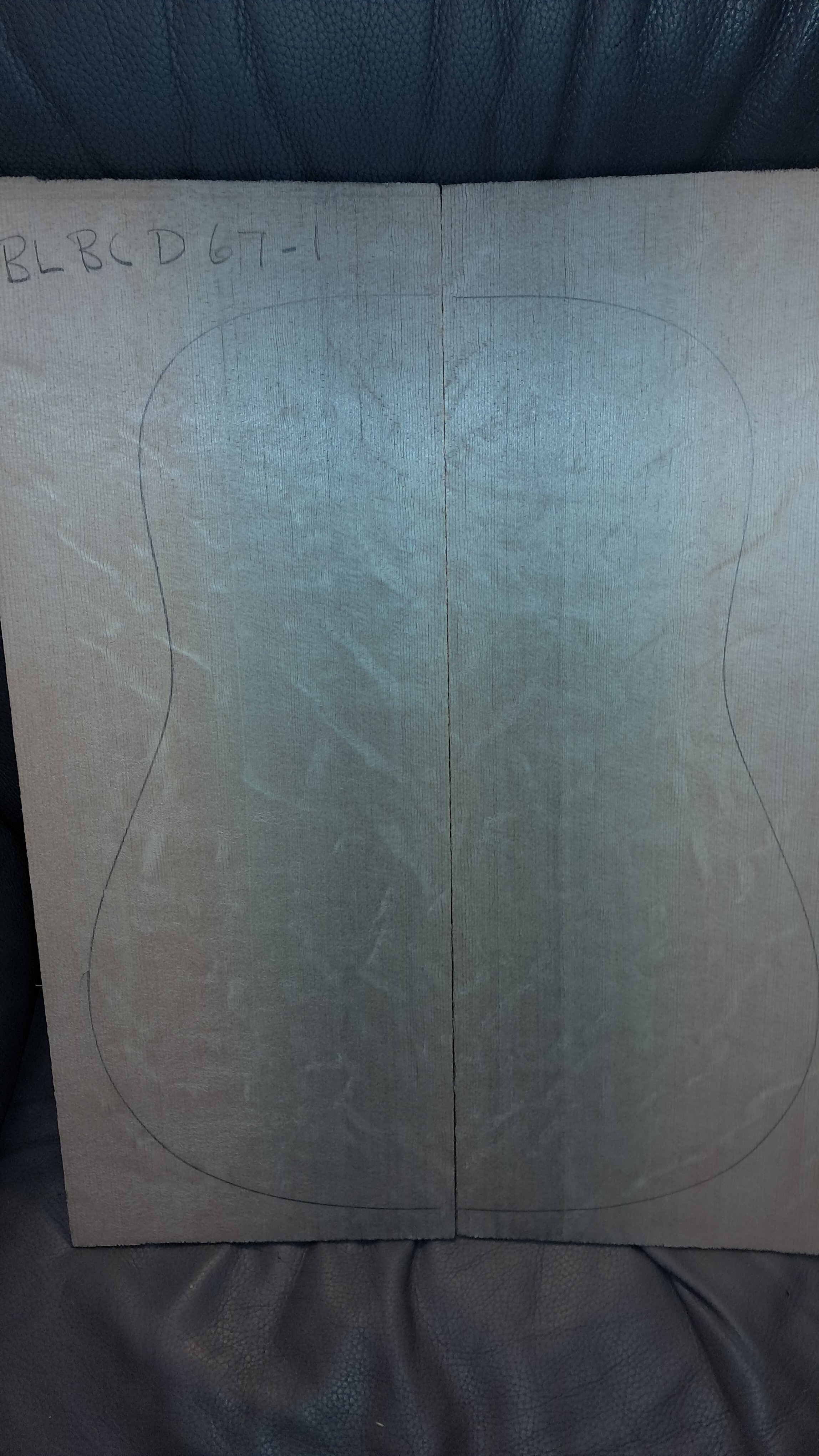
Sitka spruce is a gift we have in abundance in the Northwest, so the top was an easy decision. I found a set with an unusual history and a reasonable expectation that it should sound killer.
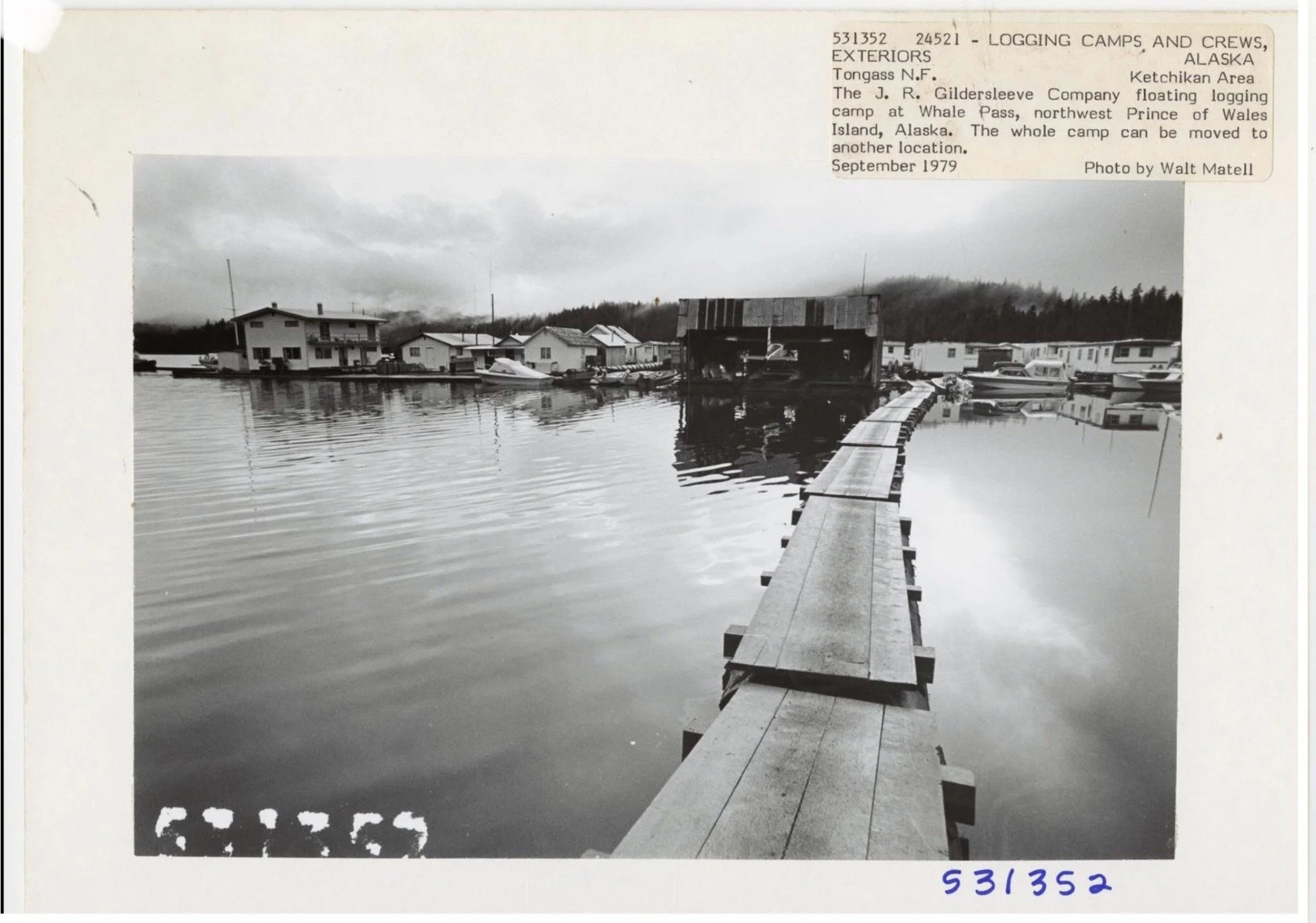
In the later decades of the last century there were floating logging camps in the fiords of Southeast Alaska. The floats were built from old-growth Sitka, lashed together with galvanized cable, while the camps traveled from fiord to fiord.
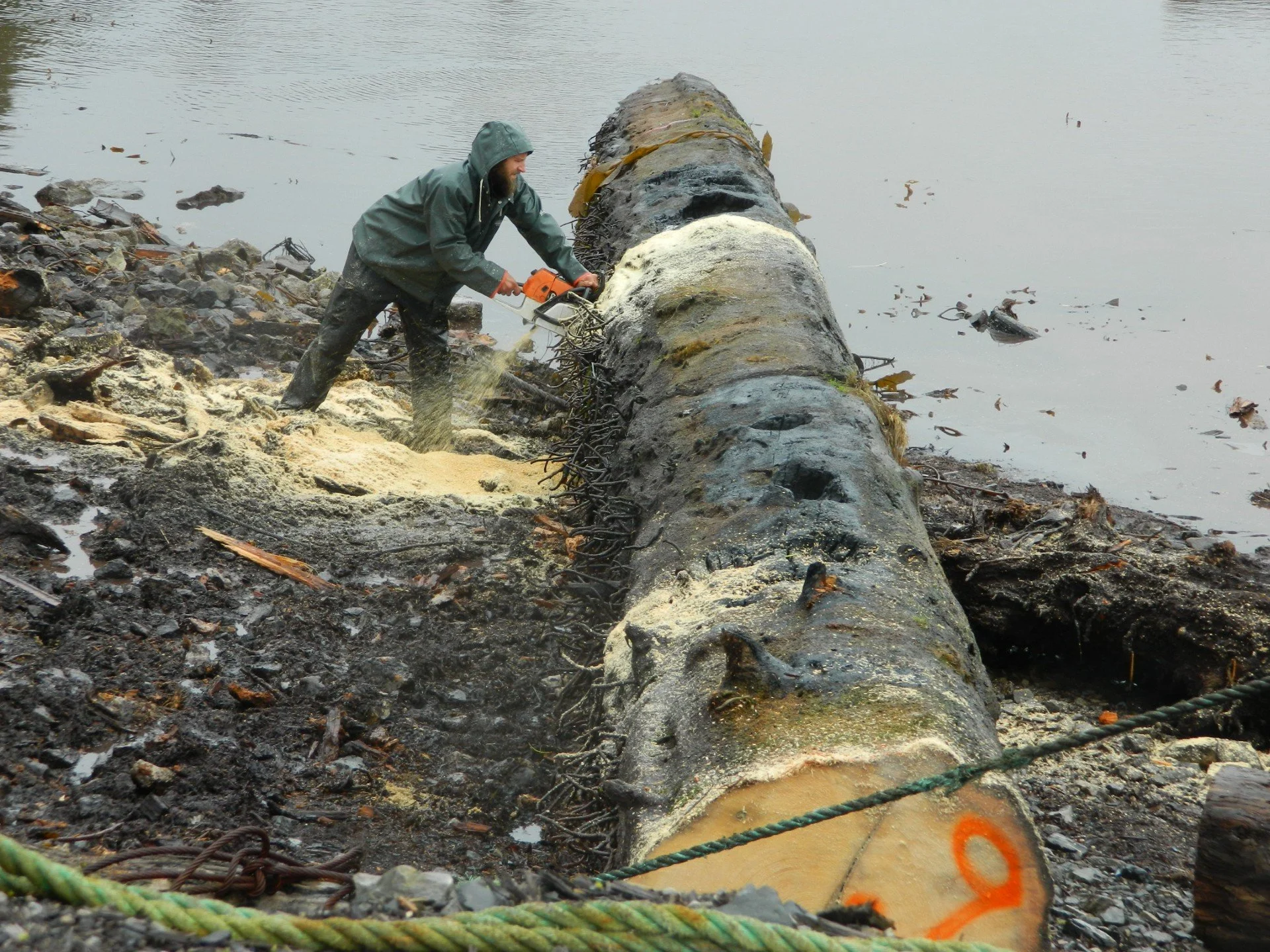
Wood that spends a long time submerged can change. Usually it rots. Sometimes it survives and becomes stiffer — luthiers call this kind of wood “sinker.” The Sitka I chose for Blue Flame was cut from salvaged float logs. A galvanized cable left a blue stain in the wood — a beauty mark that inspired this guitar’s name.
It is hard to know how long the log floated in the ocean before it was milled into guitar wood – a safe guess would be at least 30 years. (Insert: photo of the top and the Alaska logging camps)
Back and sides – Myrtlewood, chosen for its flame
Back and sides are where the dreadnought family usually declares itself: mahogany for a D-18, rosewood for the D-28. Since my criteria rule out tropical woods, I needed a Northwest wood that could still live in that traditional tonal neighborhood.
I considered bigleaf maple, Douglas fir, myrtlewood, and local walnut. I eliminated Douglas fir for this build (too soft for what I’m aiming at), and I set maple aside because it can lean a little thin sounding in a dreadnought context. That left me shopping hard for myrtle and Claro walnut sets.
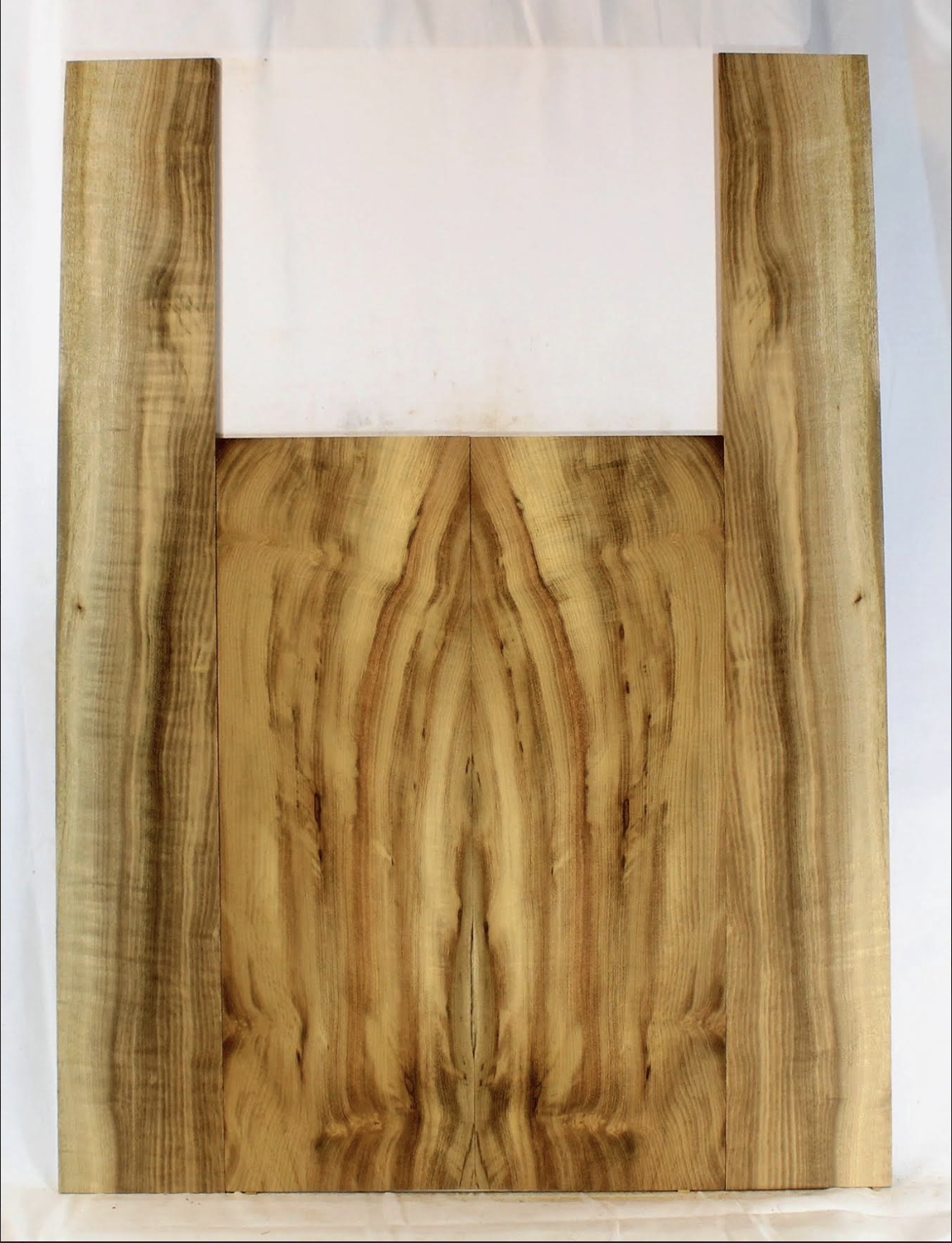
Myrtlewood eventually won my heart because it has so much character. After looking at pictures of several hundred sets, I chose a myrtle set with flame that reads like fire rising, but with straight grain that will bend cleanly.
This set was salvaged from a logging operation near Gold Beach, Oregon (Mussel Creek watershed) where myrtle was considered a nuisance and destined for the chipper. It was salvaged in 2018, and the harvested area was replanted.
(Insert: photo of the myrtle set and a small map)
Neck – Maple makes a lovely neck
Mahogany is the usual neck wood for bluegrass dreadnoughts: stable, musical, easy to work – but being a tropical wood, Mahogany is not an option. Instead, I chose to use maple, which shares many physical characteristics with mahogany.
There are many approaches to creating a neck, but for this build I decided to have a CNC neck manufactured from billets I chose. This will yield 2 necks from a billet typical used to carve only a single neck.
I’m having necks CNC’ed from two different maples: rock maple and ambrosia maple (a soft maple with blue-gray character from beetles and fungus). Ambrosia maple is closer to mahogany in weight and feel, and with possible blue tinted markings that fit the Blue Flame theme, it likely will be the neck I chose to use.
Fretboard – Madrone if it behaves, Bodark if it doesn’t
A fretboard takes abuse. Ebony became the standard for bluegrass fretboards because it’s hard, stable, and rings. The Northwest doesn’t offer many native woods hard enough to be a fretboard— but madrone is one exception.
If you’ve seen a twisted evergreen-leafed tree with peeling bark and a pretty reddish wood underneath while in the San Juan Islands or along a rocky coastline, you’ve seen madrone. It’s iconic to the northwest, but it’s also notoriously difficult as lumber: it twists, checks, and splits while drying.
I found a small billet from a kiln-dried stash in Gig Harbor and milled several prototype boards. If it stays straight over the next few months, madrone is my first choice. If it doesn’t, I have a backup: Osage orange (Bois d’Arc/bodark) — famously hard and durable, and strong enough to stand up to any hillbilly’s rambunctious G-runs.
Inside parts, trim, and headplate – the supporting cast
Some of the best parts of a guitar are the parts you never see. For internal blocks and linings I’m using Alaskan yellow cedar — wonderful stuff to work, and very much of this region. The internal braces will be carved from Sitka spruce.
For binding trim I have some donated walnut strips from Eastern Oregon (wild claro walnut). For the headplate I’m going to have options on hand — myrtle, box elder, claro walnut, and bigleaf maple — and choose what looks right once the guitar is coming together. The plan is a custom “Blue Flame” headstock inlay.
A nod to tradition
A few pieces are deliberate nods to the bluegrass tradition. The bridge will be from Brazilian rosewood. The bridge plate will be persimmon — the only ebony native to North America. And as an acknowledgement of the Barnburner itself, the neck block (the heart of the guitar) will be red alder which was the main tonewood used in the guitar that won Barnburner Year One.
My hope is simple: that the winner feels not only rewarded, but connected — to the people who show up for this music, and to the land and materials that made this instrument possible.
Your input
If you want to help shape the final “player interface” — neck feel, trim choices, and how traditional vs. bass-forward the voicing should lean — please take the short survey:
Appendix: Build notes for the guitar nerds
If you like the technical side, here are the notes I’m using to keep local woods in familiar tonal roles. I’m avoiding the decimal-heavy engineering approach in the main story, but the basic idea is still the same: compare substitutes by where they fall on the spectrum of weight, hardness, and stiffness.
Part
Wood
Role / expectation
Top
Sitka spruce (salvaged float logs)
Traditional spruce role; stiffer “sinker” character; blue-stain story
Back/sides
Myrtlewood (Gold Beach, OR; salvaged)
PNW wood aiming between mahogany dryness and rosewood complexity
Neck
Ambrosia maple / rock maple
Stable neck wood; ambrosia closer to mahogany feel; blue character fits theme
Fretboard
Madrone (preferred) / Osage orange (backup)
Hard-wearing surface; madrone for iconic PNW identity if stable
Blocks/linings
Alaskan yellow cedar
Light, fragrant, workable; strong PNW identity
Binding
Claro walnut (Eastern Oregon)
Warm visual frame; regional connection
Bridge
Brazilian rosewood
Traditional nod; proven bridge material
Bridge plate
Persimmon
North America’s only ebony
Neck block
Red alder
Barnburner continuity; “heart of the guitar”